
Charles-Jules Guiguer de Prangins (1780-1840)
On 24 January 1798, the national representatives declared the Pays de Vaud's independence from Bern. Charles-Jules Guiguer de Prangins enlisted in the Vaud military forces as a lieutenant to join the liberation struggle alongside the French forces. He was promoted to captain within a year, and later, as a general, commanded the Swiss forces in 1831 and 1838.
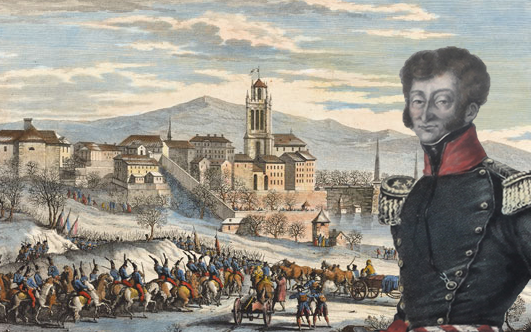
Charles-Jules Guiguer de Prangins, son of Louis-François Guiguer, Baron of Prangins, was born in Prangins on 26 August 1780. This aristocratic family, which originated from St. Gallen, had settled in the Vaud at the beginning of the century. Charles-Jules was an officer in the French military and studied humanities at the Universities of Leipzig and Gottingen.
Commissioned as captain in the first auxiliary brigade of the French army in 1799, he took part in both the First and the Second Battle of Zurich under the orders of French general André Massena. In 1802, he commanded a unit of Swiss hussars, and in 1803, he was appointed battalion commander and joined the General Staff of the Helvetic Republic's army. In 1805, only 25 years old, he became a colonel and was appointed commander of the second brigade. He was also in a commanding position during the occupation of the borders in 1809, 1813 and 1815. On 3 July 1815, in response to the French bombing of the city of Basel, he led the campaign in the Franche-Comté, the last offensive Swiss military operation on foreign territory in Swiss history. In 1817, Louis XVIII appointed him colonel in the King of France's Swiss Guard Regiment. He also worked with Guillaume-Henri Dufour to found the Thun military school in 1819, becoming its first commander.
With the end of the foreign service in France in 1830, he was appointed Federal Commissioner and tasked with repatriating the disbanded Swiss regiments. In December 1830, the Swiss Tagsatzung (legislative and executive council of the Swiss Confederation) promoted him to general and supreme commander of the Swiss military forces, and put him in charge of protecting Switzerland's borders during the July revolution, which had threatened to spread from France into Switzerland. In 1838, Charles-Jules Guiguer de Prangins, the first French native speaking general, was summoned again to assume the responsibility for defending the Swiss borders from the threat from France, which was demanding the extradition of Louis Napoleon Bonaparte. After Napoleon's voluntary departure for England, the troops were demobilised on 16 October.
Charles-Jules Guiguer de Prangins was also a member of the Grand Council of the Lake Geneva Region (from 1814) and a State Councillor (1827-1830), and actively participated in the revision of the Constitution (1830). He died on 7 July 1840 in Lausanne.